
Vital Signs Monitoring Program
Visit the Vital Signs Data Hub
Guided by the Management Plan, we designed this program to measure the health of the Columbia River Gorge National Scenic Area (National Scenic Area). This program helps us understand how well we are protecting the scenic, natural, cultural, and recreation resources and supporting the economy of the National Scenic Area. We work with the USDA Forest Service, the Gorge counties, the Columbia River treaty tribes, and other key partners to look at data to help with this goal.
What is a Vital Sign?
Vital Signs are high level measures of the health of the National Scenic Area. They represent important parts of this place protected in the Management Plan, including the habitats and communities here. Each Vital Sign has one or more indicators that include the specific datasets that measure the condition of each Vital Sign. To see an example of a Vital Sign and an Indicator, please check out this slide.
What Vital Signs and Indicators Are We Measuring?
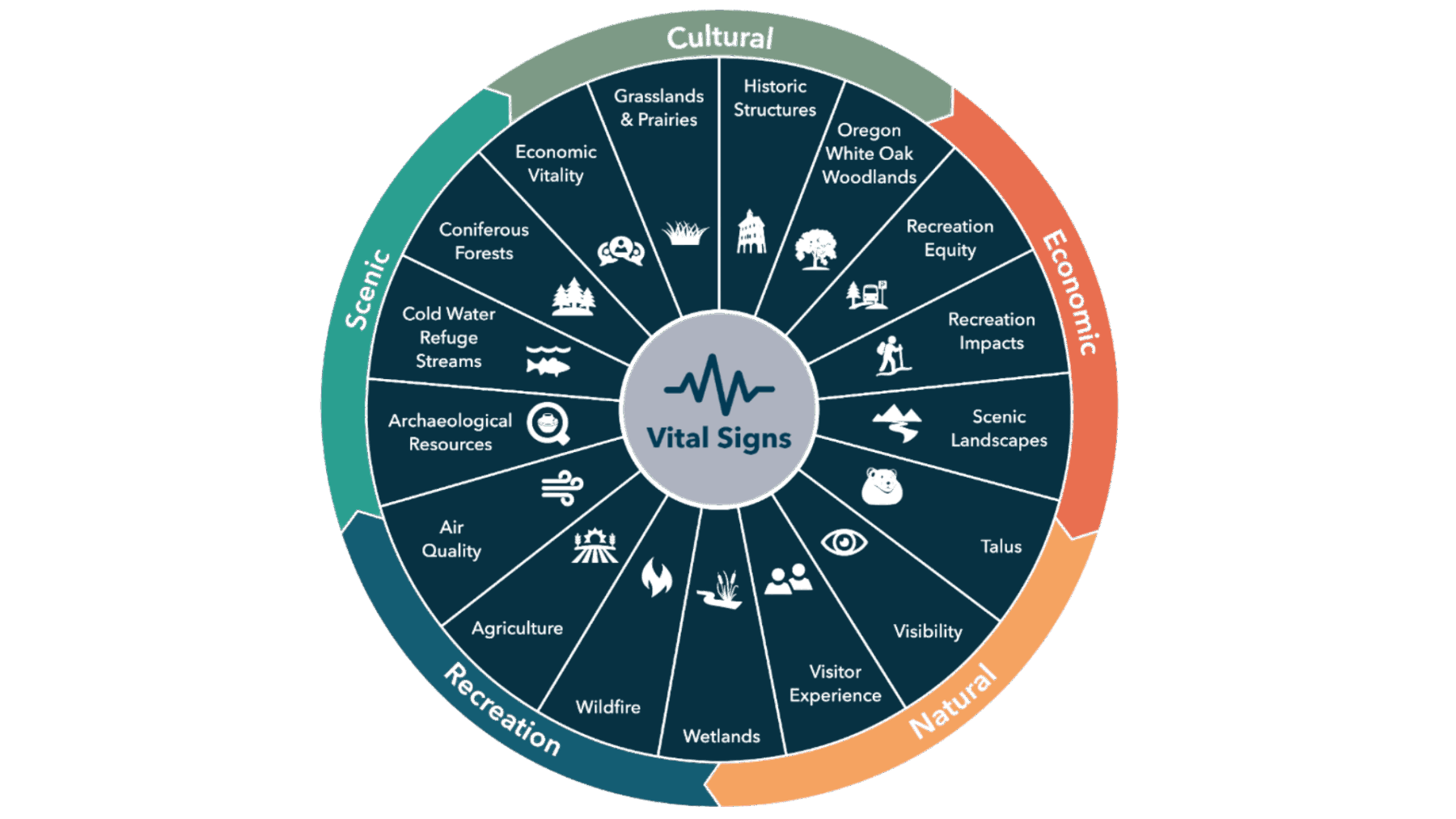
The circle below shows the 17 Vital Signs we are using to understand the long-term health of the National Scenic Area.
How Did We Choose the Vital Signs and Indicators?
The original Vital Signs and Indicators were created with a group of technical advisors, partners, and community members through work that began in 2007. A list of 51 indicators was developed to reflect the conditions of the National Scenic Area and an initial report was produced in 2009.
After we adopted the revised Management Plan in 2020, the program was updated with indicators that reflect current management priorities. This list considers climate change impacts and data availability. Indicators were selected based on their relevance, clarity, feasibility, and ability to track long-term trends to tell the story of the health of the National Scenic Area over time.
In December of 2023, the Columbia River Gorge Commission approved the final list of 17 Vital Signs and 34 Indicators. To learn more, review the Recommended Vital Sign Indicators List Staff Report.
Resources
Below you will find all the staff reports related to the development of the Vital Signs Monitoring Program since 2021.
Staff Reports
July 8, 2025 – Vital Sign Indicators Portal
March 11, 2025 – Vital Sign Indicators Overview
October 8, 2024 – Vital Sign Indicators Monitoring Program Quarterly Progress Report
July 9, 2024 – Vital Sign Indicators Monitoring Program Quarterly Progress Report
December 12, 2023 – Recommended Vital Sign Indicators List
October 10, 2023 – Vital Sign Indicators Program Quarterly Progress Report
July 11, 2023 – Vital Sign Indicators Program Quarterly Progress Report
May 9, 2023 – VSI Progress Report for Draft Cultural Resource Indicators
December 13, 2022 – VSI Progress Report for Draft Recreation Indicators
October 11, 2022 – VSI Progress Report for Draft Economic Vitality Indicators
April 12, 2022 – VSI Progress Report for Draft Scenic Indicators
December 14, 2021 – VSI Natural Resource and Climate Change Indicators Progress Report
August 10, 2021 – VSI Scenic & Recreation Resources Progress Report
June 8, 2021 – VSI Natural Resource & Climate Change Indicators Progress Report
February 9, 2021 – VSI Assessment – Framework for updating and implementing the VSI program in 2021-22.
To Learn More
Visit the interactive Vital Signs Data Hub to learn more about the indicators, play with the datasets, and see how we are using the data to guide management strategies in the Columbia River Gorge National Scenic Area.
For more information, please contact Sage Ebel, Vital Signs Program Manager at
sage.ebel@gorgecommission.org.